
 PhD in Computer Science, University of Chicago
Bocheon (Kenny) Gim is a Ph.D. student and HCI researcher at the University of Chicago, advised by Prof. Pedro Lopes at the Human Computer Integration Lab. He received his B.S. degree in Electrical Engineering and Computer Science and his M.S. degree in Intelligent Robotics at the Gwangju Institute of Science and Technology. His research lies at the intersection of human-computer interaction, virtual reality, and multisensory interfaces, with a focus on embodied interaction and perceptual augmentation.
Action required
Problem: The current root path of this site is "baseurl ("_config.yml.
Solution: Please set the
baseurl in _config.yml to "Education
-
University of ChicagoDepartment of Computer Science
PhD Student
Advisor: Prof. Pedro LopesSep. 2026 - present -
 Gwangju Institute of Science and TechnologyCollege of Information and Computing
Master's Student
Thesis: Enabling Active Locomotion in In-Car VR through Contextual Cues
Advisor: Prof. SeungJun KimMar. 2024 - Feb. 2026 -
Gwangju Institute of Science and TechnologyB.S. in Electrical Engineering and Computer Science
Thesis: Utilizing Real-Time Video Matting for Real Hand Visualization and Interaction within Augmented Virtuality
Advisor: Prof. Jeany Son, Prof. SeungJun KimMar. 2018 - Feb. 2024
Experience
-
University of ChicagoHuman Computer Integration Lab.
Research AssistantSep. 2026 - present -
Gwangju Institute of Science and TechnologyHuman-Centered Intelligent Systems Lab.
Research Intern & AssistantJul. 2022 - Feb. 2026 -
 Republic of Korea Air Force (ROKAF)English Translator & Training Systems Administrator
Completed Obligation at Staff Sgt.Jun. 2020 - Feb. 2022 -
 Hankuk Academy of Foreign StudiesHAFS Camp Senior Teacher (West-Point class)Dec 2019 - Feb 2020
News
Selected publications from top-tier conferences in HCI (CHI, UIST, ISMAR) (view all )
EMSWalker: Integrating Gait-Synchronized Electrical Muscle Stimulation for Seated Walking-in-Place in Virtual Reality
Juwon Um, Seongjun Kang, Bocheon Gim, Yumin Kang, Gwangbin Kim, Semoo Shin, Joseph DelPreto, Daniela Rus, Seungjun Kim
ISMAR 2026: IEEE International Symposium on Mixed and Augmented Reality (COND. ACCEPTED) 2026

We present EMSWalker, a system that provides proprioceptive feedback during seated walking-in-place by delivering gait-synchronized electrical muscle stimulation (EMS) to the leg muscles involved in walking (quadriceps, tibialis anterior, and gastrocnemius). By mapping foot tapping to the human gait cycle, EMSWalker renders virtual walking sensations for level, uphill, and downhill locomotion while users remain seated. Through three user studies, we evaluate (1) cognitive remapping from seated walking-in-place to walking, (2) discrimination of terrain-specific EMS patterns, and (3) EMSWalker’s effects on virtual walking experience. Results show that EMSWalker significantly increased proprioceptive drift and embodiment relative to other conditions, enabled above-chance discrimination of slope-specific stimulation patterns, and improved spatial presence and realism in a VR walking experience with flat and sloped terrain. These findings demonstrate that gait-synchronized, terrain-adaptive EMS can enrich seated VR locomotion by providing more coherent proprioceptive feedback and a more realistic, spatially immersive walking experience.
EMSWalker: Integrating Gait-Synchronized Electrical Muscle Stimulation for Seated Walking-in-Place in Virtual Reality
Juwon Um, Seongjun Kang, Bocheon Gim, Yumin Kang, Gwangbin Kim, Semoo Shin, Joseph DelPreto, Daniela Rus, Seungjun Kim
ISMAR 2026: IEEE International Symposium on Mixed and Augmented Reality(COND. ACCEPTED) 2026
We present EMSWalker, a system that provides proprioceptive feedback during seated walking-in-place by delivering gait-synchronized electrical muscle stimulation (EMS) to the leg muscles involved in walking (quadriceps, tibialis anterior, and gastrocnemius). By mapping foot tapping to the human gait cycle, EMSWalker renders virtual walking sensations for level, uphill, and downhill locomotion while users remain seated. Through three user studies, we evaluate (1) cognitive remapping from seated walking-in-place to walking, (2) discrimination of terrain-specific EMS patterns, and (3) EMSWalker’s effects on virtual walking experience. Results show that EMSWalker significantly increased proprioceptive drift and embodiment relative to other conditions, enabled above-chance discrimination of slope-specific stimulation patterns, and improved spatial presence and realism in a VR walking experience with flat and sloped terrain. These findings demonstrate that gait-synchronized, terrain-adaptive EMS can enrich seated VR locomotion by providing more coherent proprioceptive feedback and a more realistic, spatially immersive walking experience.
SelfBlending: Artificial Intelligence-driven Augmentation with Hand Interactions for Seamless Reality Blending in Virtual Environments
Ahmed Elsharkawy, Bocheon Gim, Aya Ataya, Seungjun Kim
IEEE Transactions on Visualization and Computer Graphics (TVCG) 2026
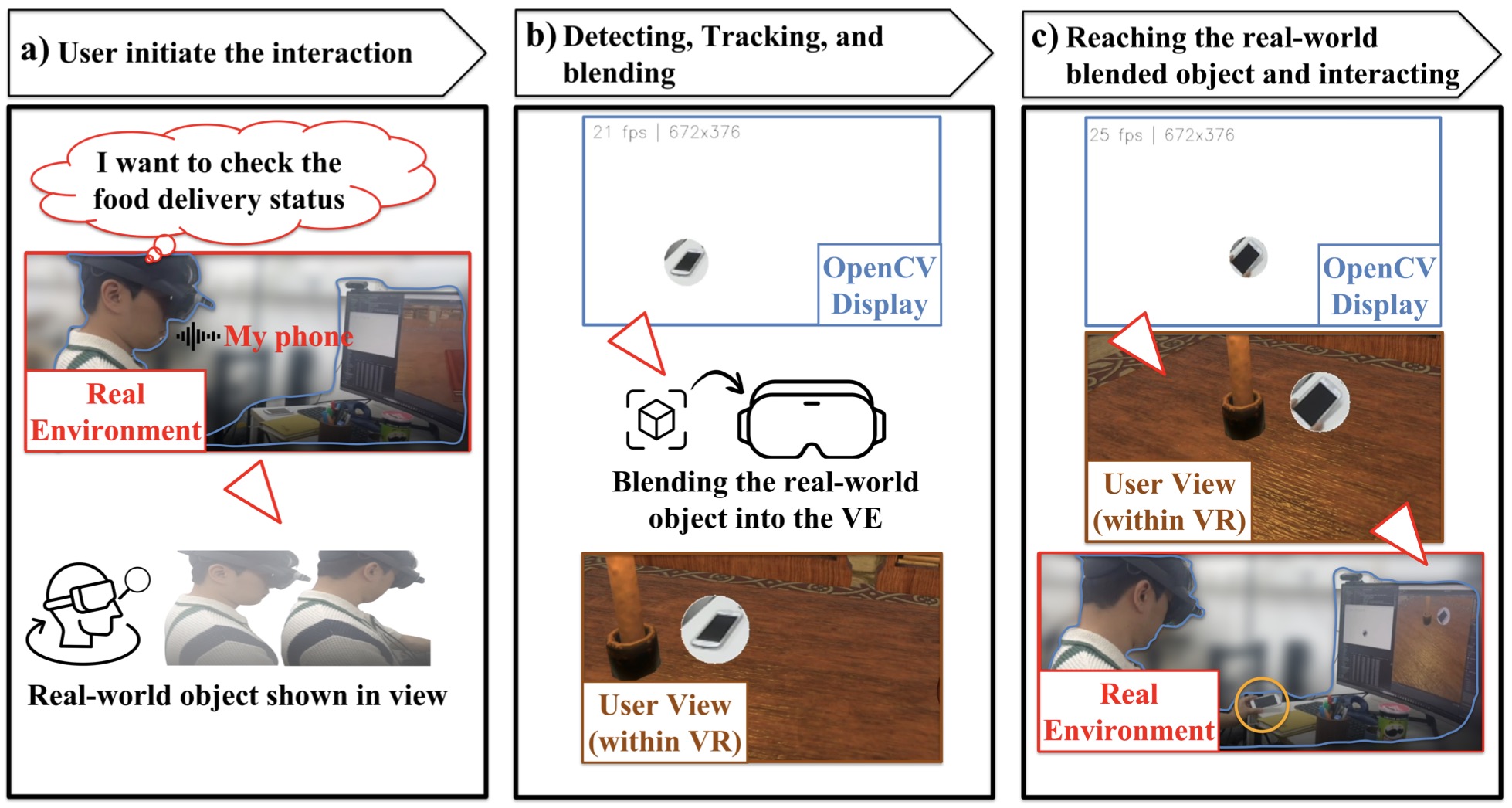
Accessing real-world objects during immersive virtual reality (VR) experiences remains challenging, as current cross-reality systems often rely on predefined interaction steps, tracking devices/markers, or fixed object setups. They also lack support for personalized object recall, where users can add, remove, or modify real-world items blended into the virtual environment (VE). Many head-mounted displays (HMDs) include passthrough technology to switch between virtual and real worlds, but it often disrupts immersion by requiring a full shift from virtual to real. Thus, maintaining an optimal balance between virtuality and reality is difficult. To address these challenges, we developed SelfBlending, a framework that uses AI-based hand tracking to let users label physical objects through freehand gestures, then blends the selected item into the VE using object recognition, enabling interaction with the relevant real-world object. SelfBlending was evaluated against two common interaction conditions: the default passthrough feature in VR HMDs and the conventional approach of physically removing the HMD to access real-world objects. Results from seated, single-object interactions with tabletop-placed items showed that SelfBlending enhanced user experience by boosting presence, supporting efficient physical interaction, and improving cross-reality continuity. It also enabled selective interaction with real objects while minimizing the disruption of VR experience.
SelfBlending: Artificial Intelligence-driven Augmentation with Hand Interactions for Seamless Reality Blending in Virtual Environments
Ahmed Elsharkawy, Bocheon Gim, Aya Ataya, Seungjun Kim
IEEE Transactions on Visualization and Computer Graphics (TVCG) 2026
Accessing real-world objects during immersive virtual reality (VR) experiences remains challenging, as current cross-reality systems often rely on predefined interaction steps, tracking devices/markers, or fixed object setups. They also lack support for personalized object recall, where users can add, remove, or modify real-world items blended into the virtual environment (VE). Many head-mounted displays (HMDs) include passthrough technology to switch between virtual and real worlds, but it often disrupts immersion by requiring a full shift from virtual to real. Thus, maintaining an optimal balance between virtuality and reality is difficult. To address these challenges, we developed SelfBlending, a framework that uses AI-based hand tracking to let users label physical objects through freehand gestures, then blends the selected item into the VE using object recognition, enabling interaction with the relevant real-world object. SelfBlending was evaluated against two common interaction conditions: the default passthrough feature in VR HMDs and the conventional approach of physically removing the HMD to access real-world objects. Results from seated, single-object interactions with tabletop-placed items showed that SelfBlending enhanced user experience by boosting presence, supporting efficient physical interaction, and improving cross-reality continuity. It also enabled selective interaction with real objects while minimizing the disruption of VR experience.
From Disruption to Immersion: Reimagining Vehicle Motion as Environmental Feedback through Force Mappings in In-Car VR
Bocheon Gim, Seongjun Kang, Gwangbin Kim, Dohyeon Yeo, Yumin Kang, Ahmed Elsharkawy, Seungjun Kim
CHI'26: Proceedings of the CHI Conference on Human Factors in Computing Systems 2026 1st Author
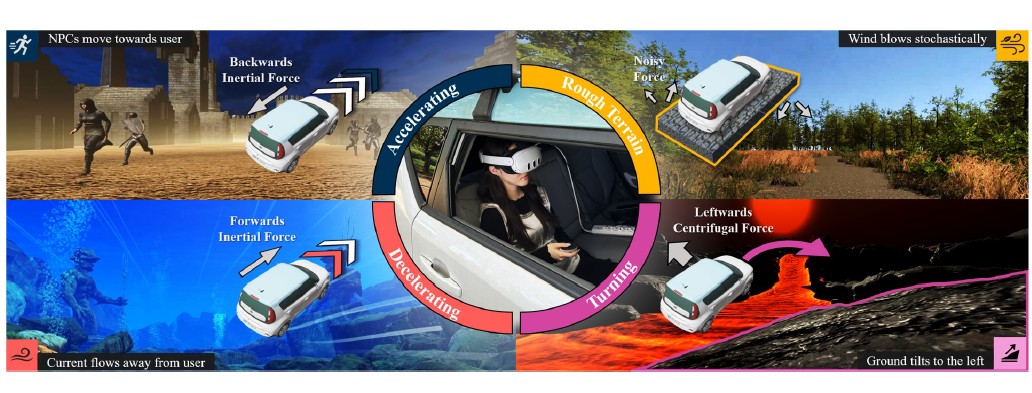
We present a novel approach to in-car virtual reality (VR) that reimagines vehicle-generated forces not as artifacts to suppress, but as immersive feedback cues for enhancing presence and interaction. We introduce the concept of force mappings, a design space that translates vehicle-induced forces such as acceleration, turns, and road texture into ambient environmental representations within VR environments. Implemented on a real vehicle platform with a sensor-based pipeline, our system applies four representative mapping strategies (Ground-based, Wind-based, Current-based, Object-based) and evaluates their perceptual coherence and experiential effects through two respective user studies. Results show that force mappings can improve presence, comfort, and engagement while enabling creative reinterpretations of physical motion. Finally. we provide empirical findings and design guidelines that position vehicle motion as a generative medium for multisensory in-car VR applications.
From Disruption to Immersion: Reimagining Vehicle Motion as Environmental Feedback through Force Mappings in In-Car VR
Bocheon Gim, Seongjun Kang, Gwangbin Kim, Dohyeon Yeo, Yumin Kang, Ahmed Elsharkawy, Seungjun Kim
CHI'26: Proceedings of the CHI Conference on Human Factors in Computing Systems 2026 1st Author
We present a novel approach to in-car virtual reality (VR) that reimagines vehicle-generated forces not as artifacts to suppress, but as immersive feedback cues for enhancing presence and interaction. We introduce the concept of force mappings, a design space that translates vehicle-induced forces such as acceleration, turns, and road texture into ambient environmental representations within VR environments. Implemented on a real vehicle platform with a sensor-based pipeline, our system applies four representative mapping strategies (Ground-based, Wind-based, Current-based, Object-based) and evaluates their perceptual coherence and experiential effects through two respective user studies. Results show that force mappings can improve presence, comfort, and engagement while enabling creative reinterpretations of physical motion. Finally. we provide empirical findings and design guidelines that position vehicle motion as a generative medium for multisensory in-car VR applications.
When Fingers Become Tools: Rendering Virtual Tool Inertia with a Finger-Mounted Extending Rod
Seongjun Kang, Gwangbin Kim, Bocheon Gim, Jeongju Park, Juwon Um, Semoo Shin, Chanyoung Park, Seungjun Kim
CHI'26: Proceedings of the CHI Conference on Human Factors in Computing Systems 2026
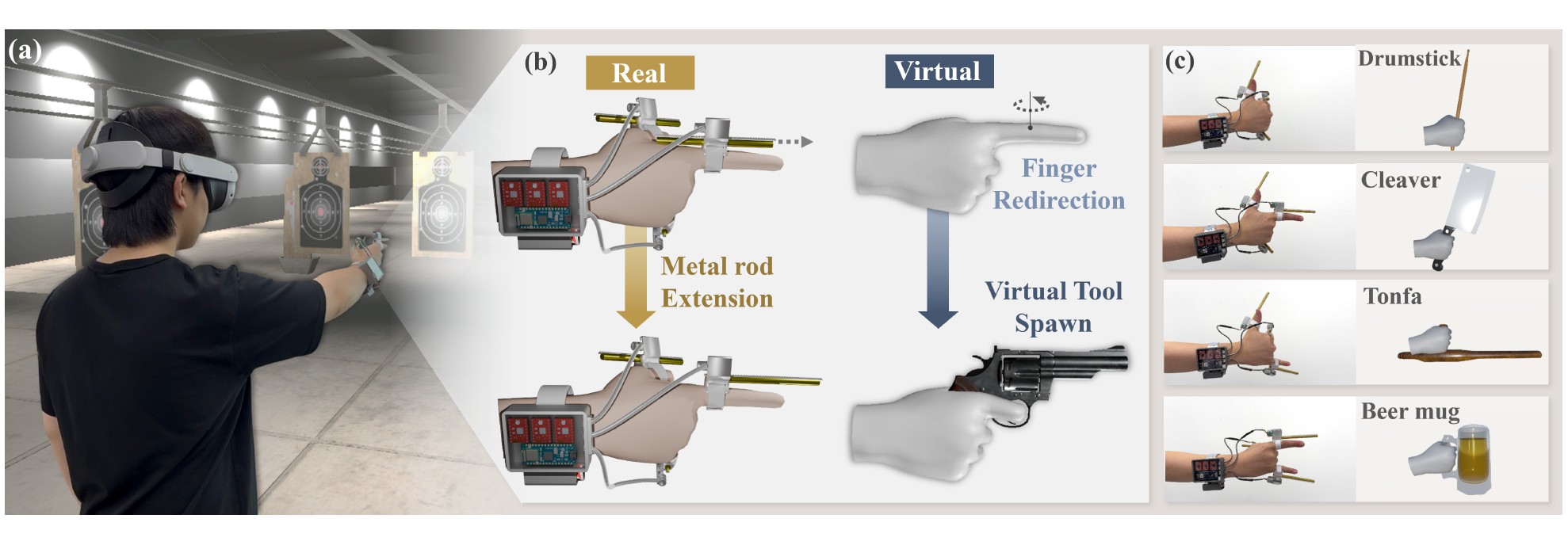
This paper presents the Finger-Mounted Extending Rod, a wearable device that transforms fingers into virtual tools by modulating fingertip mass distribution. The system employs linear actuators on finger that extend or retract metal rods according to finger poses, generating rotational inertia while redirecting the hand to natural grip postures. Through three user studies, we evaluate (1) finger pose embodiment under visual redirection and tool matching via inertia tensor similarity, (2) perception of tool length and rotational inertia, and (3) tool identification accuracy and user experience. Results show that 10 of 15 poses maintained embodiment, with inertia tensor similarities of 0.936–0.991 for tool-pose pairs. Users perceived inertia with 4.19–10.45× amplification and achieved 52.9% identification accuracy, exceeding chance level (16.7%). The Inertia-aligned condition enhanced immersion, realism, and enjoyment compared to Inertia-misaligned and No-Finger Rod conditions across six VR scenarios. We conclude by discussing how the system rendering virtual tools without handheld controllers.
When Fingers Become Tools: Rendering Virtual Tool Inertia with a Finger-Mounted Extending Rod
Seongjun Kang, Gwangbin Kim, Bocheon Gim, Jeongju Park, Juwon Um, Semoo Shin, Chanyoung Park, Seungjun Kim
CHI'26: Proceedings of the CHI Conference on Human Factors in Computing Systems 2026
This paper presents the Finger-Mounted Extending Rod, a wearable device that transforms fingers into virtual tools by modulating fingertip mass distribution. The system employs linear actuators on finger that extend or retract metal rods according to finger poses, generating rotational inertia while redirecting the hand to natural grip postures. Through three user studies, we evaluate (1) finger pose embodiment under visual redirection and tool matching via inertia tensor similarity, (2) perception of tool length and rotational inertia, and (3) tool identification accuracy and user experience. Results show that 10 of 15 poses maintained embodiment, with inertia tensor similarities of 0.936–0.991 for tool-pose pairs. Users perceived inertia with 4.19–10.45× amplification and achieved 52.9% identification accuracy, exceeding chance level (16.7%). The Inertia-aligned condition enhanced immersion, realism, and enjoyment compared to Inertia-misaligned and No-Finger Rod conditions across six VR scenarios. We conclude by discussing how the system rendering virtual tools without handheld controllers.
Defying Gravity: Towards Gravitoinertial Retargeting of Acceleration for Virtual Vertical Motion in In-Car VR
Bocheon Gim, Seongjun Kang, Dohyeon Yeo, Gwangbin Kim, Juwon Um, Jeongju Park, Seungjun Kim
ISMAR 2025: IEEE International Symposium on Mixed and Augmented Reality 2025 1st Author
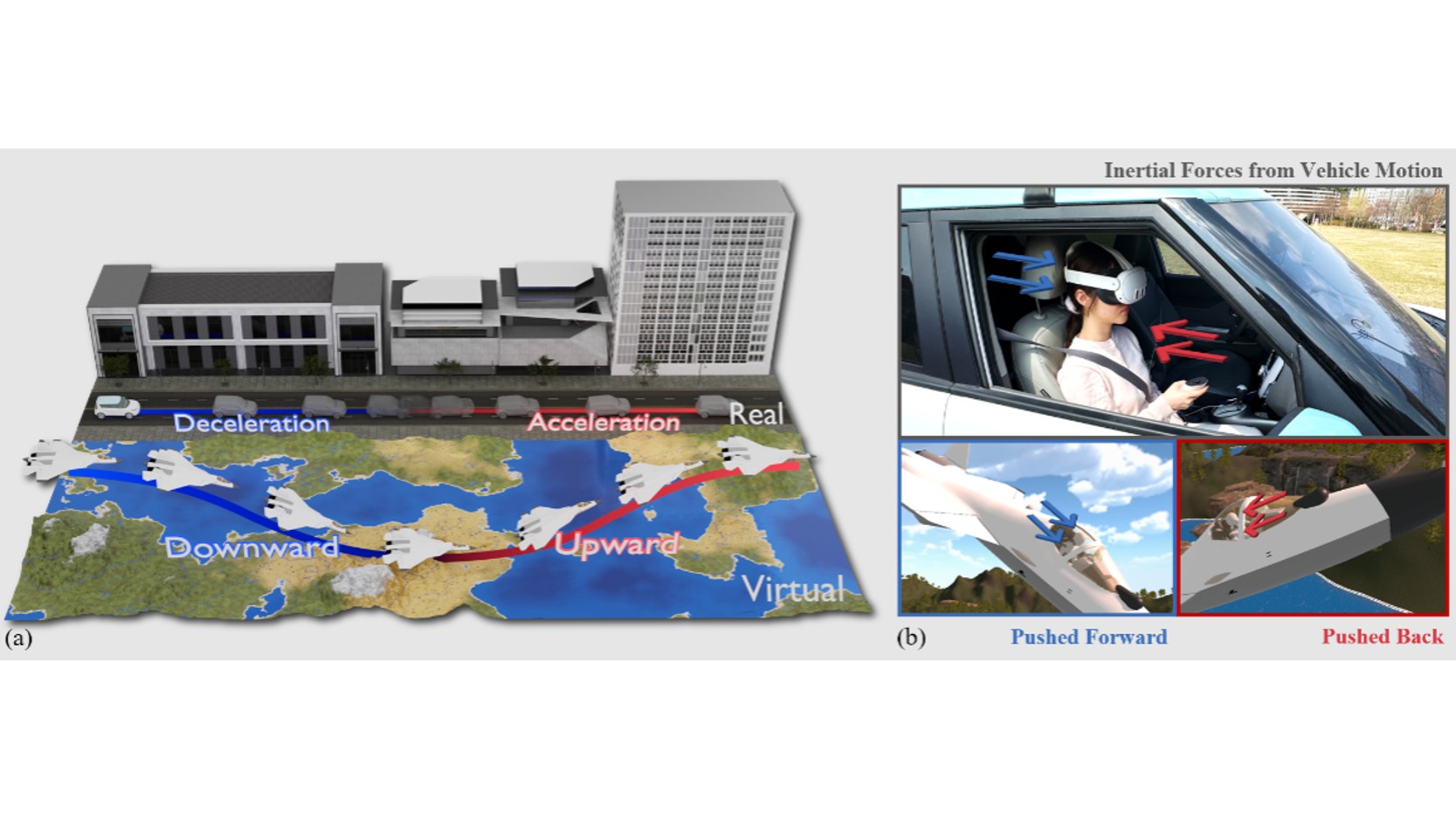
In-car VR applications typically synchronize virtual motion with real vehicle movement to minimize visual-vestibular mismatch. However, this approach limits virtual movement to directions in which the vehicle can physically move, typically restricting the experience to horizontal motion. This study introduces a method to expand the range of virtual motion by simulating vertical movement, leveraging vehicle acceleration to induce a vertical pitch illusion via manipulation of gravitoinertial perception. We conducted a two-phase study evaluating (1) optimal vertical gain values for maximizing perceptual realism in a controlled environment and (2) user experience factors such as motion sickness and presence in an on-road VR flight simulation under realistic driving conditions. Our findings show that users tend to prefer vertical gains that exceed theoretically valid mappings, and highlight the importance of aligning virtual motion with perceived inertial cues to enhance the realism and coherence of vertical motion in in-car VR applications.
Defying Gravity: Towards Gravitoinertial Retargeting of Acceleration for Virtual Vertical Motion in In-Car VR
Bocheon Gim, Seongjun Kang, Dohyeon Yeo, Gwangbin Kim, Juwon Um, Jeongju Park, Seungjun Kim
ISMAR 2025: IEEE International Symposium on Mixed and Augmented Reality 2025 1st Author
In-car VR applications typically synchronize virtual motion with real vehicle movement to minimize visual-vestibular mismatch. However, this approach limits virtual movement to directions in which the vehicle can physically move, typically restricting the experience to horizontal motion. This study introduces a method to expand the range of virtual motion by simulating vertical movement, leveraging vehicle acceleration to induce a vertical pitch illusion via manipulation of gravitoinertial perception. We conducted a two-phase study evaluating (1) optimal vertical gain values for maximizing perceptual realism in a controlled environment and (2) user experience factors such as motion sickness and presence in an on-road VR flight simulation under realistic driving conditions. Our findings show that users tend to prefer vertical gains that exceed theoretically valid mappings, and highlight the importance of aligning virtual motion with perceived inertial cues to enhance the realism and coherence of vertical motion in in-car VR applications.
EarPressure VR: Ear Canal Pressure Feedback for Enhancing Environmental Presence in Virtual Reality
Seongjun Kang, Gwangbin Kim, Bocheon Gim, Jeongju Park, Semoo Shin, Seungjun Kim
UIST '25: Proceedings of the ACM Symposium on User Interface Software and Technology 2025
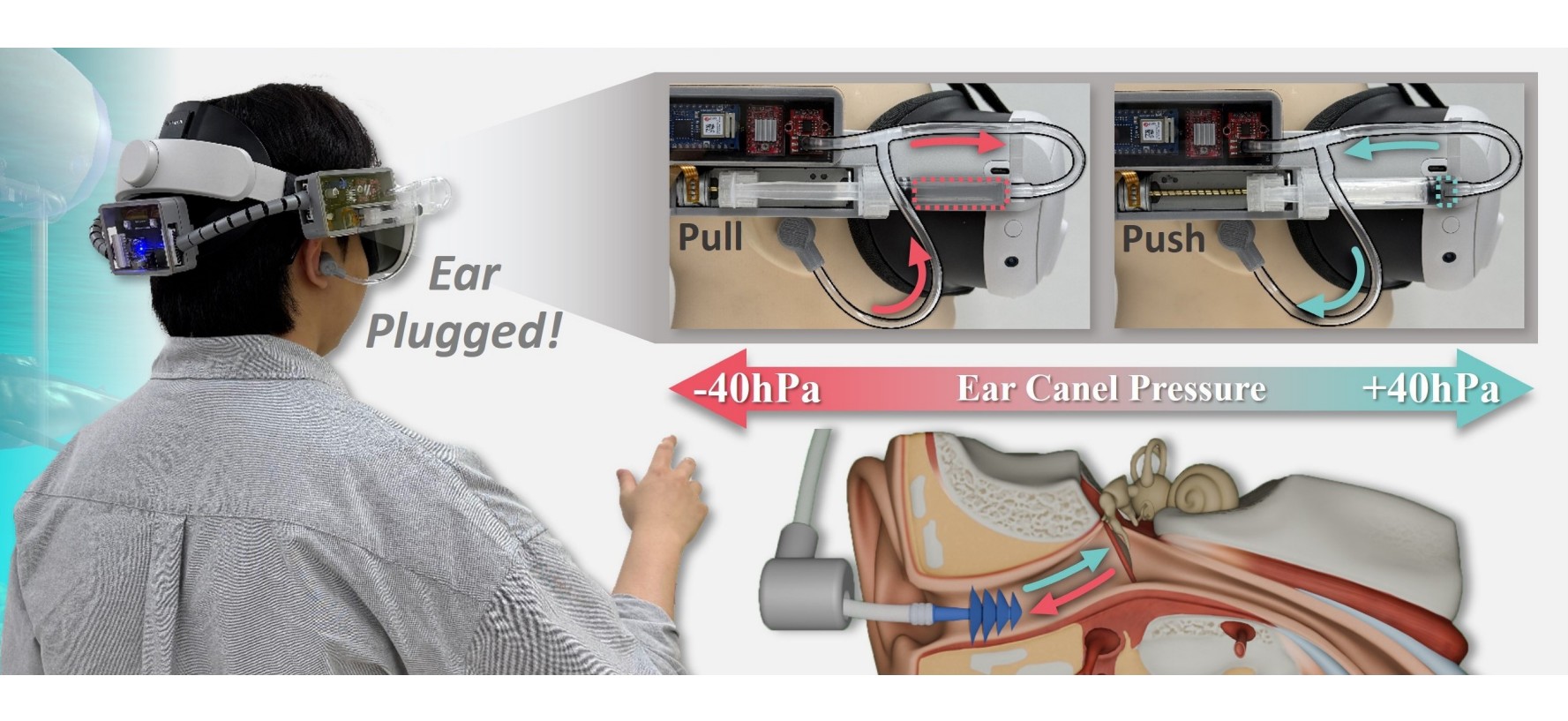
This study presents EarPressure VR, a system that modulates ear canal pressure to simulate atmospheric pressure changes in virtual reality (VR). EarPressure VR employs sealed earbuds and a linear stepper motor–driven syringe to generate controlled pressure variations within safe limits (±40 hPa relative to ambient pressure). Through two user studies, we evaluate (1) perceptual thresholds for detecting ear pressure in terms of direction (inward or outward) and intensity differences, and (2) the effect of ear pressure feedback on users’ sense of environmental presence across two VR scenarios involving gradual and discrete changes in ambient pressure. Results show that participants reliably identified pressure direction at thresholds of +14.4 hPa (inward) and –23.8 hPa (outward), and intensity differences at ±14.6% and ±34.9%, respectively. Pressure feedback significantly improved presence ratings, particularly when pressure variation was continuously adjusted to reflect environmental transitions. We conclude by discussing the broader applicability of ear canal pressure feedback in areas such as training, simulation, and everyday experiences.
EarPressure VR: Ear Canal Pressure Feedback for Enhancing Environmental Presence in Virtual Reality
Seongjun Kang, Gwangbin Kim, Bocheon Gim, Jeongju Park, Semoo Shin, Seungjun Kim
UIST '25: Proceedings of the ACM Symposium on User Interface Software and Technology 2025
This study presents EarPressure VR, a system that modulates ear canal pressure to simulate atmospheric pressure changes in virtual reality (VR). EarPressure VR employs sealed earbuds and a linear stepper motor–driven syringe to generate controlled pressure variations within safe limits (±40 hPa relative to ambient pressure). Through two user studies, we evaluate (1) perceptual thresholds for detecting ear pressure in terms of direction (inward or outward) and intensity differences, and (2) the effect of ear pressure feedback on users’ sense of environmental presence across two VR scenarios involving gradual and discrete changes in ambient pressure. Results show that participants reliably identified pressure direction at thresholds of +14.4 hPa (inward) and –23.8 hPa (outward), and intensity differences at ±14.6% and ±34.9%, respectively. Pressure feedback significantly improved presence ratings, particularly when pressure variation was continuously adjusted to reflect environmental transitions. We conclude by discussing the broader applicability of ear canal pressure feedback in areas such as training, simulation, and everyday experiences.
AttraCar: Multisensory In-Car VR with Thermal, Airflow, and Motion Feedback through Built-In Vehicle Systems
Dohyeon Yeo, Gwangbin Kim, Minwoo Oh, Jeongju Park, Bocheon Gim, Seongjun Kang, Ahmed Elsharkawy, Seungjun Kim
UIST '25: Proceedings of the ACM Symposium on User Interface Software and Technology 2025
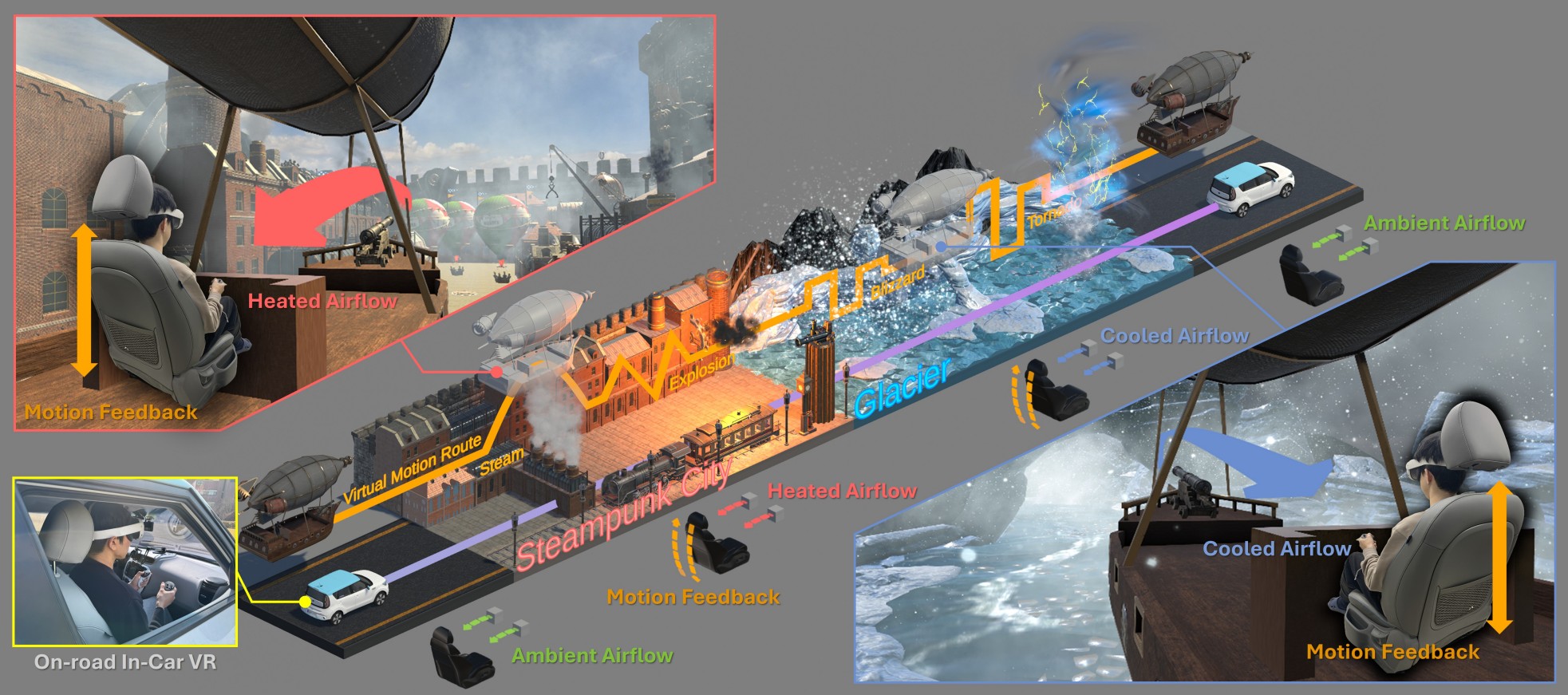
We introduce AttraCar, a novel multisensory in-car Virtual Reality (VR) platform that delivers thermal, airflow, and motion feedback using built-in vehicle systems. Leveraging the Heating, Ventilation, and Air Conditioning (HVAC) system for airflow and thermal variation, and the power seat for motion feedback, perceptual thresholds were determined through Just Noticeable Difference (JND) experiments. A user study evaluated six feedback conditions (Baseline, Ambient Airflow, Thermal Airflow, Seat Motion, Ambient Airflow + Seat Motion, Thermal Airflow + Seat Motion) during on-road VR scenarios. A subsequent on-road study demonstrates that different combinations of feedback are not only perceptually distinct but also highly effective in a dynamic VR context, significantly mitigating motion sickness and enhancing presence and haptic experience. We conclude with reflections on design considerations, integration challenges, and real-world applicability for scalable multisensory in-car VR systems utilizing existing vehicle components.
AttraCar: Multisensory In-Car VR with Thermal, Airflow, and Motion Feedback through Built-In Vehicle Systems
Dohyeon Yeo, Gwangbin Kim, Minwoo Oh, Jeongju Park, Bocheon Gim, Seongjun Kang, Ahmed Elsharkawy, Seungjun Kim
UIST '25: Proceedings of the ACM Symposium on User Interface Software and Technology 2025
We introduce AttraCar, a novel multisensory in-car Virtual Reality (VR) platform that delivers thermal, airflow, and motion feedback using built-in vehicle systems. Leveraging the Heating, Ventilation, and Air Conditioning (HVAC) system for airflow and thermal variation, and the power seat for motion feedback, perceptual thresholds were determined through Just Noticeable Difference (JND) experiments. A user study evaluated six feedback conditions (Baseline, Ambient Airflow, Thermal Airflow, Seat Motion, Ambient Airflow + Seat Motion, Thermal Airflow + Seat Motion) during on-road VR scenarios. A subsequent on-road study demonstrates that different combinations of feedback are not only perceptually distinct but also highly effective in a dynamic VR context, significantly mitigating motion sickness and enhancing presence and haptic experience. We conclude with reflections on design considerations, integration challenges, and real-world applicability for scalable multisensory in-car VR systems utilizing existing vehicle components.
I Want to Break Free: Enabling User-Applied Active Locomotion in In-Car VR through Contextual Cues
Bocheon Gim, Seokhyun Hwang, Seongjun Kang, Gwangbin Kim, Dohyeon Yeo, Seungjun Kim
CHI '25: Proceedings of the CHI Conference on Human Factors in Computing Systems 2025 1st Author
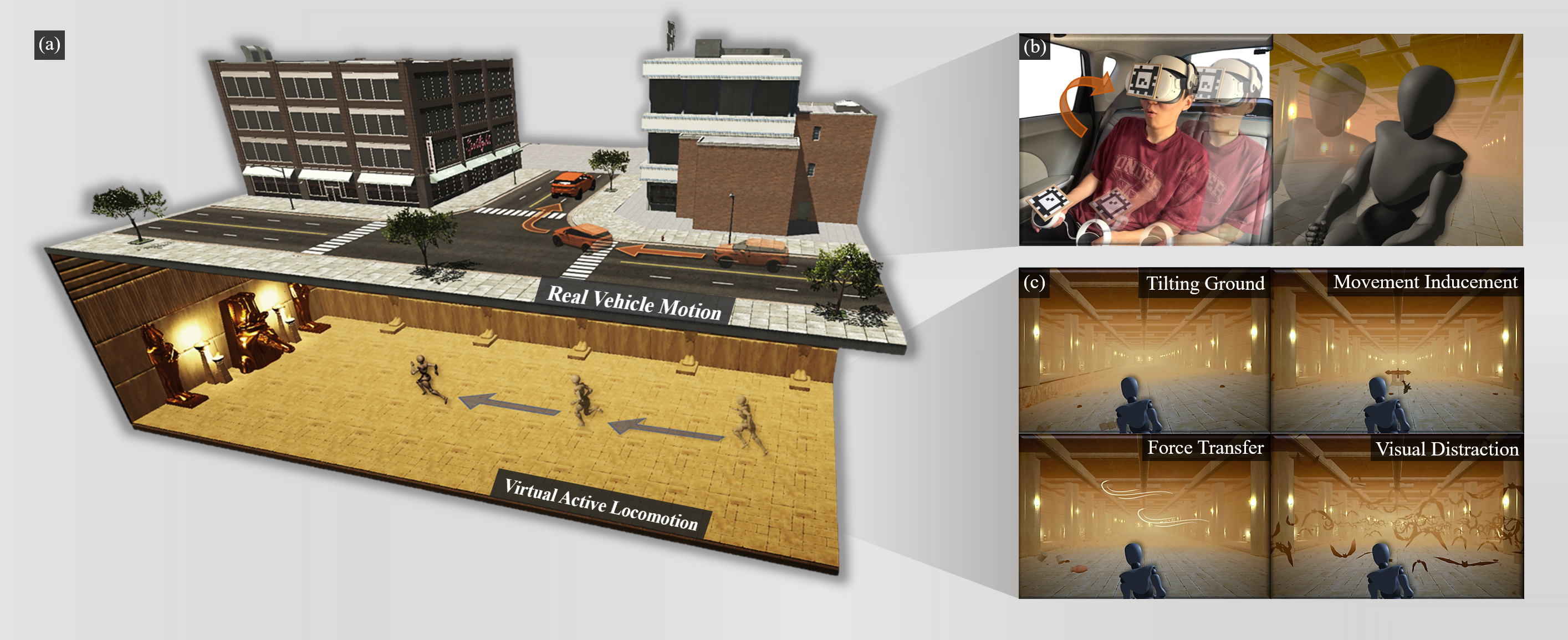
We explore the feasibility of active user-applied locomotion in virtual reality (VR) within in-car environments through a two-step study, by examining the effects of locomotion method on user experience in dynamic environments as well as evaluating contextual cues designed to mitigate sensory mismatch posed by vehicle movement. The first study evaluated five locomotion methods, identifying joystick-based navigation as the most suitable for in-car use due to its low physical demand and stability within the dynamic vehicle environment. The second study focused on designing and testing various contextual cues that translate vehicle movements into virtual effects, aiming to integrate sensory inputs from the vehicle without limiting the user’s freedom of movement. Along with results in which the implemented contextual cues effectively lowered motion sickness and increased presence, we conclude with a set of initial insights and design considerations into expanding the range of potential in-car VR applications by enabling active locomotion.
I Want to Break Free: Enabling User-Applied Active Locomotion in In-Car VR through Contextual Cues
Bocheon Gim, Seokhyun Hwang, Seongjun Kang, Gwangbin Kim, Dohyeon Yeo, Seungjun Kim
CHI '25: Proceedings of the CHI Conference on Human Factors in Computing Systems 2025 1st Author
We explore the feasibility of active user-applied locomotion in virtual reality (VR) within in-car environments through a two-step study, by examining the effects of locomotion method on user experience in dynamic environments as well as evaluating contextual cues designed to mitigate sensory mismatch posed by vehicle movement. The first study evaluated five locomotion methods, identifying joystick-based navigation as the most suitable for in-car use due to its low physical demand and stability within the dynamic vehicle environment. The second study focused on designing and testing various contextual cues that translate vehicle movements into virtual effects, aiming to integrate sensory inputs from the vehicle without limiting the user’s freedom of movement. Along with results in which the implemented contextual cues effectively lowered motion sickness and increased presence, we conclude with a set of initial insights and design considerations into expanding the range of potential in-car VR applications by enabling active locomotion.